
Quick Answer
Third-party Ayurvedic manufacturing in India runs ₹25 to ₹110 per unit in 2026, depending on what you’re making — tablets and capsules sit at the higher end, powders and churnas at the lower. Budget ₹1–2.5 lakh for your first real production run once you factor in packaging, licensing (AYUSH, FSSAI, GST), and a round of formulation trials. That figure moves mostly on four things: your order size, ingredient grade, packaging choice, and whether you’re testing for export.
Getting your ayurvedic products manufactured costs around 1 lakh- 2.5 lakh INR in India. However, this is a standard rate that can vary.
Ask ten herbal brand owners what they paid for their first production run. You’ll get ten different numbers. That’s the reality of Ayurvedic third-party manufacturing cost in India: it is determined by what you make, how much you order, and who makes it. This guide sets out real 2026 figures, so you can plan your budget before you sign with a manufacturer, not after.
What Third-Party Manufacturing Actually Means
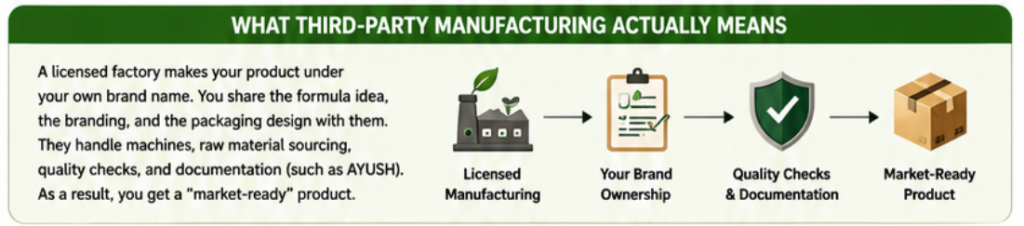
A licensed factory makes your product under your own brand name. You share the formula idea, the branding, and the packaging design with them. They have machines, raw material sourcing, and quality checks, along with the documentation (such as AYUSH). As a result, you get a “market-ready” product.
Most new herbal brands opt for this option. After all, building your own factory before you have sold a single bottle takes years, and huge investment as well.
With third-party manufacturing, you can save your money for marketing and sales.
What Drives Ayurvedic Third Party Manufacturing Cost in India
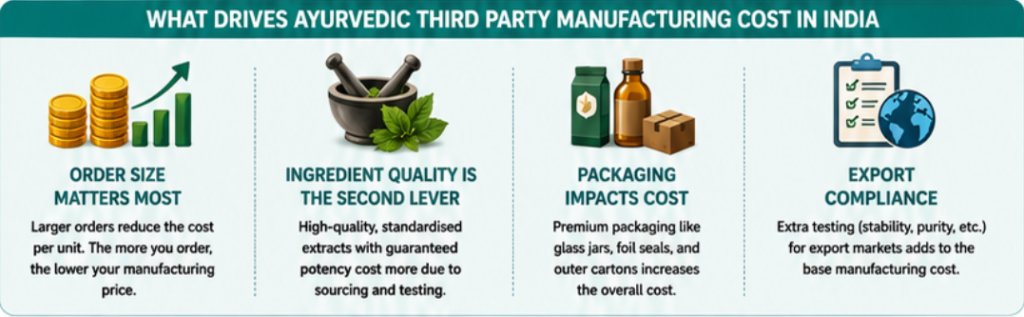
Four things impact the cost of Ayurvedic contract manufacturing.
Order size matters most.
A manufacturer that runs 5,000 bottles pays less per unit in labour and machine time than one running 1,000. This way, the Ayurvedic third-party manufacturing cost per product drops with the larger quantity. If you can commit to a larger first batch, negotiate on that basis. The order size also sets your Ayurvedic third-party manufacturing price.
Ingredient quality is the second lever.
Plain herbal powder costs far less than a standardised extract with a guaranteed strength. If your brand makes potency claims, you’ll pay for the sourcing and testing behind them. That raises your Ayurvedic product manufacturing cost.
Packaging
Packaging is where budget quietly goes up. A basic plastic bottle with a printed label costs a fraction of a glass jar with foil sealing and a rigid outer carton. Decide early whether you want a premium shelf look or a value one. Switching later gets expensive fast.
Export compliance
Regulatory work is the fourth factor. Standard batch testing usually sits inside your quoted Ayurvedic third-party manufacturing price. But export markets often ask for extra tests, like stability checks or purity screening. Those add on top of the base cost.
2026 Pricing Breakdown by Product Category
| Product Category | Common Pack Size | Cost Per Unit (INR) | Typical MOQ |
|---|---|---|---|
| Herbal Tablets / Capsules | 60s bottle or blister | ₹40–₹90 | 1,000–2,000 bottles |
| Ayurvedic Syrups | 200 ml bottle with carton | ₹35–₹75 | 1,000–3,000 bottles |
| Herbal Hair & Body Oils | 100–200 ml bottle | ₹45–₹110 | 1,000–2,000 units |
| Herbal Churna / Powders | 100–250 g jar or pouch | ₹30–₹70 | 1,000 jars |
| Ayurvedic Creams / Ointments | 30–50 g tube | ₹25–₹60 | 2,000 tubes |
These are 2026 market averages, not fixed quotes. Your actual Ayurvedic Third Party Manufacturing Cost in India will sit above or below this range, depending on the factors covered above.
Working Out Your Total Investment
The unit price on that TABLE is only part of the picture. Before you place your first order, budget for three more things.
Brand registration and licensing come first.
Trademark filing, FSSAI or AYUSH documentation, and GST registration typically run ₹10,000 to ₹25,000 together.
Formulation trials come next.
Sample batches and lab certification for a new formula usually cost ₹5,000 to ₹15,000 each. You’ll want at least one round of trials before committing to a full run.
Your first production run is the big one.
For two or three products at a workable MOQ, expect to commit ₹1 Lakh–2.5 lakh (roughly $1,200–$3,000). That’s once manufacturing, packaging, and freight are added together.
Put those three together, and you have your real Ayurvedic Manufacturing Investment in India. It’s the figure worth having ready before you start manufacturer conversations.
Ways to Bring the Cost Down
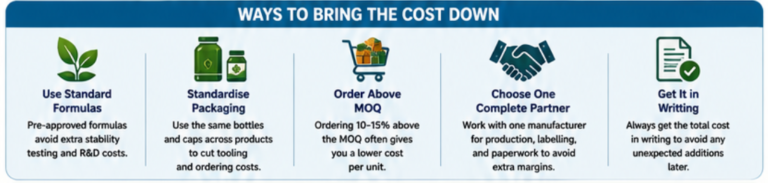
- Stick to pre-approved, standard formulas where you can. Custom formulas mean extra stability testing and R&D time.
- Standardise your packaging across your range. If three products share the same bottle and cap, you cut tooling and ordering costs right across the line. This keeps your overall Ayurvedic third-party manufacturing cost in India in check.
- Order slightly above the MOQ. Most manufacturers offer a discount once you clear the minimum threshold. An extra 10–15% on your order often costs less per unit overall.
- Pick one manufacturer who handles production, labelling, and paperwork together. Split these across three vendors, and you stack three margins on top of each other. That pushes your Ayurvedic third party manufacturing cost per product up for no real benefit.
One more thing worth saying: get your Ayurvedic third party manufacturing cost in India in writing before you commit. Verbal quotes tend to grow once packaging and testing get added in.
New Salasar Herbotech: An Affordable Option for New Brands
At New Salasar Herbotech, we keep our Ayurvedic third party manufacturing cost in India genuinely affordable for smaller first orders. Our process runs from raw material sourcing, through formula approval, to finished packaging. Our quotes are built around what you’re actually making, not a flat industry rate. Ask us for a quote now at +91 721 000 0019.
📱 Follow Us on Social Media
FAQs
Q1. How much money do I need to start Ayurvedic contract manufacturing?
Ans. For two or three basic products at standard MOQ, budget ₹1–2.5 lakh to cover your first production run, licensing, and testing. That’s a realistic starting figure for your Ayurvedic manufacturing investment in India.
Q2. What impacts the Ayurvedic Third Party Manufacturing Cost Per Product the most?
Ans. Order volume and ingredient grade matter most. Packaging choice and any extra testing follow.
Q3. How long does a production run take?
Ans. Most manufacturers quote 20 to 35 days from confirmed order to dispatch, including sourcing, production, testing, and packing. Repeat orders usually move faster once your formula is on file.
Q4. Do I need an AYUSH licence to sell my own Ayurvedic brand?
Ans. Yes. But if you work with a contract manufacturer, they’ll usually handle product approval under their own manufacturing licence. You just register separately for GST and marketing.
Q5. How much is New Salasar Herbotech’s quote?
Ans. It depends on your formulation, MOQ, and other factors. That’s why you should contact us to know what the final cost may look like.